Capital Gains Tax: Short-Term vs. Long-Term Rates, 2026 Thresholds & Optimization
A capital gain is the profit realized when you sell a capital asset — such as stocks, real estate, or collectibles — for more than its original cost basis, with the resulting gain subject to federal capital gains tax at rates dependent on the asset's holding period.
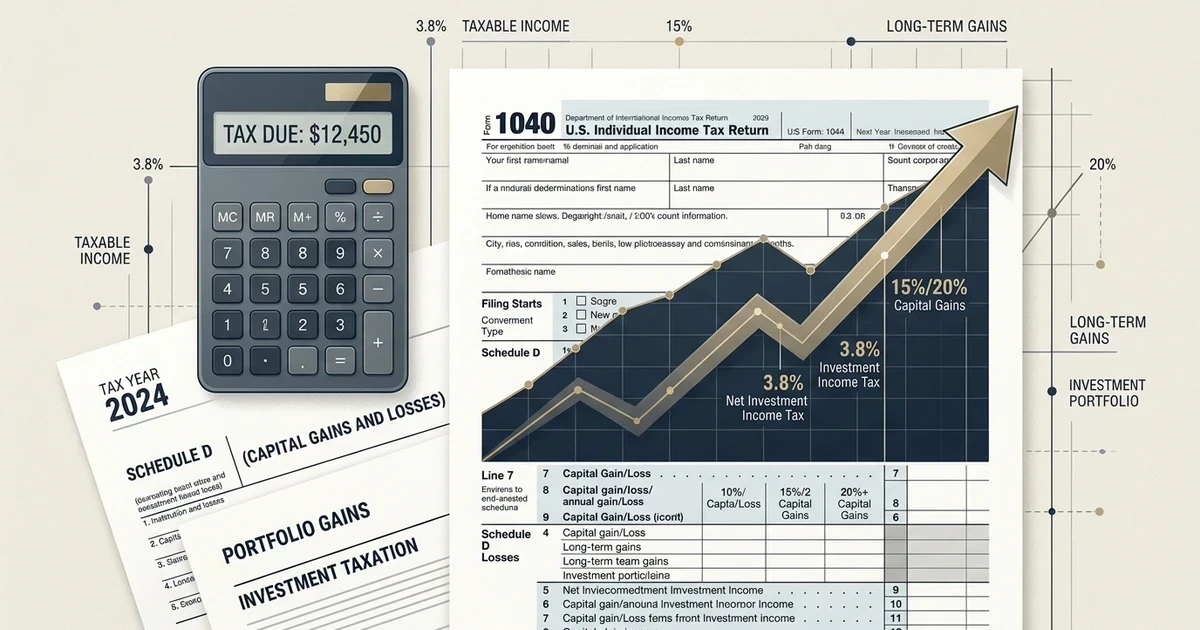
Key Takeaways
- Short-term capital gains (assets held 12 months or less) are taxed at ordinary income tax rates (10%–37%), the same as wages and salary.
- Long-term capital gains (assets held more than 12 months) qualify for preferential rates of 0%, 15%, or 20% depending on taxable income.
- High-income investors may owe an additional 3.8% Net Investment Income Tax (NIIT) on top of regular capital gains taxes, bringing the federal maximum to 23.8%.
- Tax-loss harvesting, 1031 exchanges, and stepped-up basis inheritance planning are the most powerful legal capital gains deferral and elimination tools.
The difference between short-term and long-term capital gains tax treatment is one of the most consequential distinctions in personal finance — and among the most exploitable for strategic tax planning. Structuring your investment and real estate activity to systematically favor long-term treatment can generate returns equivalent to adding percentage points to your annualized investment performance.
2026 Federal Capital Gains Tax Rate Structure
Short-Term Capital Gains (≤ 12 Months Holding Period)
Taxed as ordinary income using the same brackets as wages:
| Tax Bracket | Rate | 2026 Single Filer Income Range |
|---|---|---|
| 10% | 10% | $0 – $11,925 |
| 12% | 12% | $11,926 – $48,475 |
| 22% | 22% | $48,476 – $103,350 |
| 24% | 24% | $103,351 – $197,300 |
| 32% | 32% | $197,301 – $250,525 |
| 35% | 35% | $250,526 – $626,350 |
| 37% | 37% | Above $626,350 |
Long-Term Capital Gains (> 12 Months Holding Period)
Preferential rates for assets held longer than 12 months:
| Rate | 2026 Single Filer Threshold | 2026 Married Filing Jointly |
|---|---|---|
| 0% | Taxable income ≤ $47,025 | ≤ $94,050 |
| 15% | $47,026 – $518,900 | $94,051 – $583,750 |
| 20% | Above $518,900 | Above $583,750 |
Net Investment Income Tax (NIIT): The Hidden 3.8% Surtax
High-income investors owe an additional 3.8% NIIT on top of regular capital gains tax:
- Threshold: MAGI > $200,000 (single) or > $250,000 (MFJ)
- Applies to: All net investment income (dividends, interest, capital gains, passive income)
- Maximum combined federal rate: 20% + 3.8% = 23.8%
Real-World Calculation: Capital Gains Tax on a Stock Sale
Scenario: Priya, a single investor with $175,000 gross income, sells 500 shares of stock:
- Purchase Price: $45.00 per share (bought 18 months ago — long-term)
- Sale Price: $82.00 per share
- Gross Gain: ($82 − $45) × 500 = $18,500
Federal Tax Calculation:
- Priya’s taxable income puts her in the 15% long-term capital gains bracket
- Capital Gains Tax: $18,500 × 15% = $2,775
- Priya’s MAGI ($175,000 + $18,500 = $193,500) is below the $200,000 NIIT threshold → no NIIT
- Total Federal Tax on Gain: $2,775
If the same shares had been sold after 11 months (short-term), Priya’s marginal rate would be 22%:
- Short-term Tax: $18,500 × 22% = $4,070
- Additional Tax for Impatience: $1,295 — purely from the holding period
5 Key Capital Gains Tax Strategies
1. Tax-Loss Harvesting Sell losing positions before year-end to offset gains. Capital losses offset capital gains dollar-for-dollar, with up to $3,000 of excess losses deductible against ordinary income annually and unlimited loss carryforward.
2. Hold Beyond 12 Months for Long-Term Treatment The single most important behavioral discipline — a 22% vs. 15% rate difference on a $50,000 gain = $3,500 in additional federal taxes, simply from holding one day longer.
3. 1031 Like-Kind Exchange (Real Estate) Real estate investors can defer capital gains taxes by rolling sales proceeds into a “like-kind” replacement property within specific IRS timelines (45-day identification, 180-day closing). The deferred gain carries forward into the new property’s basis.
4. Stepped-Up Basis Inheritance Planning Appreciated assets transferred at death receive a step-up in basis to fair market value. Estate planners deliberately hold highly appreciated positions to eliminate embedded gains through natural inheritance transfer.
5. Opportunity Zone Investments Gains reinvested within 180 days into Qualified Opportunity Zone Funds (QOZFs) defer the original gain until 2026 and can permanently exclude new appreciation if held 10+ years.
Advantages & Disadvantages of Long-Term Capital Gains Treatment
| Advantages | Disadvantages |
|---|---|
| Significantly lower rates (0–20%) vs. ordinary income (up to 37%) | Requires patience — 12+ month holding period lock-up |
| 0% rate available to lower-income filers | State taxes may add 5–13% (CA, NY, NJ) on top of federal |
| Powerful combined strategies (TLH, 1031, step-up) | NIIT adds 3.8% for high earners |
| Loss carryforward provides multi-year tax shields | Complex rules require careful record-keeping of cost basis |
Tax Optimization & Wealth Preservation
Investors can minimize taxable capital gains by actively harvesting investment losses under Tax-Loss Harvesting protocols, steering clear of the IRS Wash-Sale Rule, and structuring estate transfers to benefit from the Step-Up in Basis at inheritance.
Frequently Asked Questions
- What is the difference between short-term and long-term capital gains?
- Short-term capital gains apply to assets held 12 months or less and are taxed at ordinary income rates up to 37%. Long-term capital gains apply to assets held more than 12 months and are taxed at preferential 0%, 15%, or 20% rates, creating a significant tax benefit for patient investors.
- What are the 2026 long-term capital gains tax rate thresholds?
- For 2026, long-term capital gains are taxed at 0% for single filers with taxable income up to $47,025, 15% for income between $47,026 and $518,900, and 20% for income above $518,900. Joint filers have thresholds of $94,050 (0%), $94,051–$583,750 (15%), and above (20%).
- What is the Net Investment Income Tax (NIIT)?
- The 3.8% Net Investment Income Tax applies to the lesser of net investment income or the amount by which your Modified Adjusted Gross Income exceeds $200,000 (single) or $250,000 (married filing jointly). This surtax is on top of regular capital gains tax, pushing the top federal rate to 23.8%.
- How does tax-loss harvesting reduce capital gains?
- Tax-loss harvesting involves selling securities at a loss to offset capital gains realized elsewhere in your portfolio. Up to $3,000 of net capital losses can also offset ordinary income per year, with excess losses carried forward indefinitely to future tax years.
- What is a stepped-up basis and how does it eliminate capital gains?
- When you inherit an asset, its cost basis is 'stepped up' to fair market value on the date of the decedent's death. This eliminates all unrealized capital gains accumulated during the original owner's lifetime — a powerful estate planning tool for highly appreciated assets.
The Bottom Line
Understanding Capital Gains Tax is essential for making sound financial decisions in today's complex markets. The core mechanics, formulas, and real-world scenarios outlined in this guide are regularly reviewed and updated by our credentialed editorial team to reflect the current 2026 rate environment and regulatory landscape. Whether you are a retail investor building long-term wealth or a finance professional sharpening technical knowledge, applying these principles with consistent discipline separates informed decision-making from costly financial mistakes.